

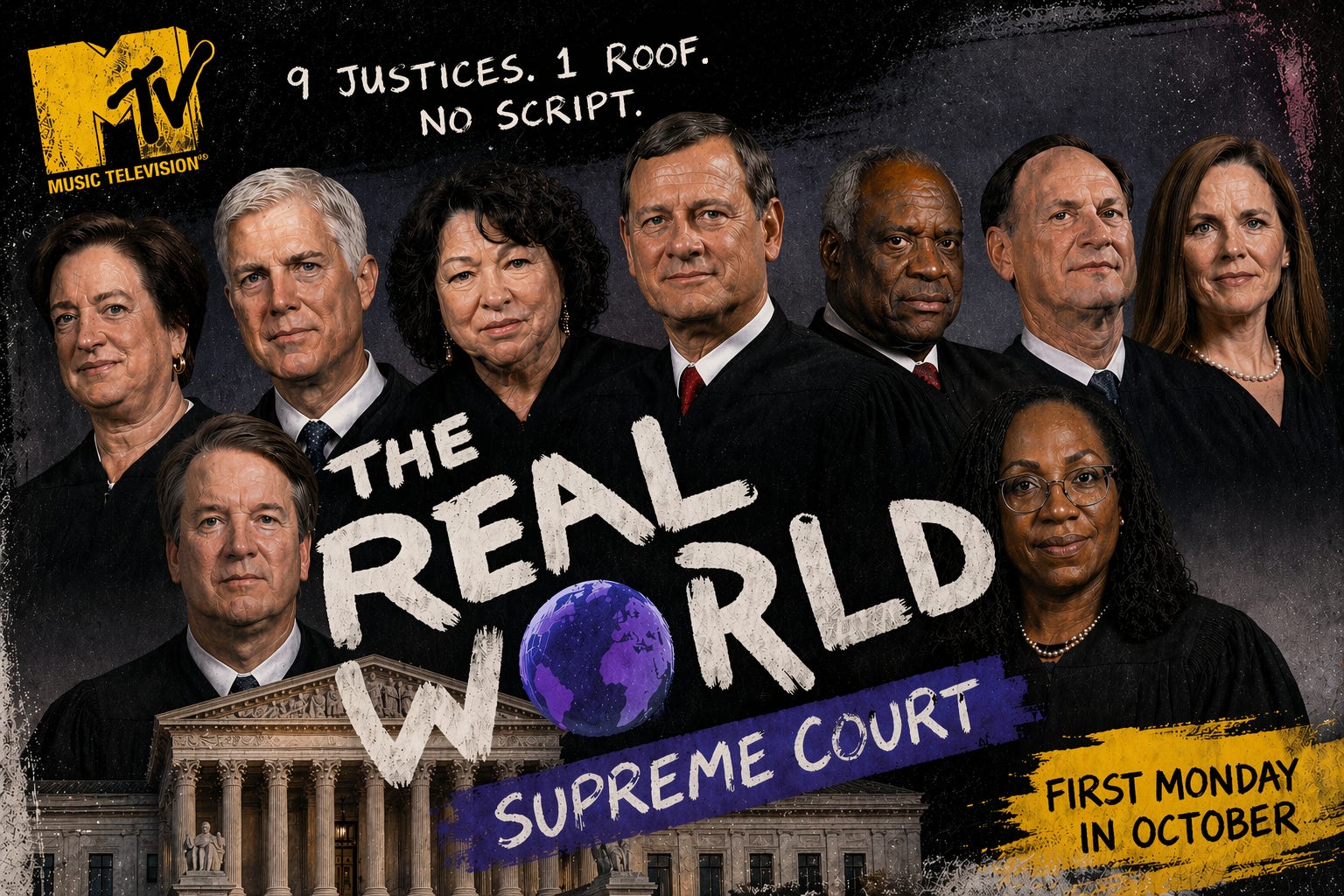
A shorter version of this article, which did not include the footnotes, originally appeared on Bloomberg Law, part of Bloomberg Industry Group, Inc. (800-372-1033). Portions of that column are reproduced here with permission.
Readers of a certain age might recall MTV’s The Real World, one of the first reality television shows, and its iconic introductory voiceover. In light of recent events, I came up with my own version of it for the U.S. Supreme Court: “This is the true story of nine strangers, picked to live in a marble palace, work together, and have their public appearances taped. Find out what happens when justices stop being polite—and start getting real.”
Over the past decade—with a former reality TV star in the White House, and Congress sometimes feeling like an episode of The Real Housewives of D.C.—the Supreme Court has been a redoubt of relative sanity in Washington. But if SCOTUS is the “last branch standing,” to borrow the title of legal commentator Sarah Isgur’s great new book about the Court, are its legs getting wobbly? Is it becoming more like the other branches of government—and not in a good way?
Justice Sonia Sotomayor leveled a somewhat personal criticism at a colleague while speaking at the University of Kansas School of Law earlier this month. In discussing Noem v. Vasquez Perdomo, an emergency-docket case where conservative justices gave the green light to certain immigration stops in Los Angeles, she referred to an unnamed colleague who wrote that “these are only temporary stops.” She continued, “This is from a man whose parents were professionals and probably doesn’t really know any person who works by the hour or the piece like I do.”
Justice Sotomayor was clearly referring to Justice Kavanaugh, the only member of the Vasquez Perdomo majority who wrote an opinion explaining his vote—and who happens to be the son of two lawyers. To her credit, Justice Sotomayor later apologized for what she called her “inappropriate” and “hurtful” remarks.1 But the fact that she made these comments in the first place is arguably revealing.2
Two days after the talk at Kansas Law, at an event at the University of Alabama Law School, Justice Sotomayor said she has “a civil relationship” with “virtually all”—but not all—of her colleagues. She added that “with many of them”—but again, not all of them—she has “a friendship.” This language struck me as materially different from what she said to CNN in 2018, shortly after Justice Kavanaugh was confirmed, when she declared that the justices are “a family…. this is our work family, and it’s just as important as our personal family.”
The following week, Justice Ketanji Brown Jackson offered a less personal, but still pointed, critique of her colleagues. In a lecture at Yale Law School, she castigated the conservative majority’s rulings on the emergency docket as “scratch-paper musings” that don’t acknowledge the real-world stakes of cases, making the decisions “seem oblivious and thus ring hollow.”
But it’s not only the liberal justices who have concerns about the current state of the Court. In an appearance this month at the University of Texas at Austin, Justice Clarence Thomas made a remark implying that relations between the justices used to be better: “I joined a Court that dealt with differences as friends. We respected each other”—past tense—and acted with “civility.”3
Then last weekend, The New York Times published an article about what reporters Jodi Kantor and Adam Liptak described as “the birth of the Supreme Court’s shadow docket,” based on leaked memos from 2016.4 We don’t know who leaked the memos—just as we don’t know who was behind the May 2022 leak of the draft majority opinion in Dobbs v. Jackson Women’s Health Organization.
I strongly doubt that any justice was involved in the leaking. But regardless of who’s responsible, the leaks, combined with the justices’ latest comments, paint a somewhat unflattering picture of the Court. In the words of Professor Jonathan Turley of George Washington University Law School, the Court, historically “an island of integrity and civility” in D.C., is starting to appear “increasingly porous and partisan.”
What’s causing this possible erosion in the Court’s collegiality and culture? Some blame probably belongs to the subject of Justice Sotomayor’s and Justice Jackson’s recent remarks: the emergency docket, also called the “shadow docket” (usually by critics) or the “interim docket” (usually by defenders).
“The interim docket may be more prone to creating tensions between the justices because they have to make decisions very quickly,” explained Professor Brian Fitzpatrick of Vanderbilt Law School, a former clerk to Justice Antonin Scalia, in an interview. “This sometimes causes them to do things that might look ill-considered in hindsight.”
“I do think the shadow docket likely plays a role,” Professor Carolyn Shapiro of the Chicago-Kent College of Law, a former clerk to Justice Stephen Breyer, told me. “The liberal justices are clearly unhappy with the way the Court is deciding very consequential things, sometimes with no explanation whatsoever, in very rushed ways—and their dissents have indicated as much.”
Another way the emergency docket could be causing relationships between the justices to fray is by forcing them to work on highly controversial cases year-round, without the cooling-off period or reset of their traditional summer recess.
“I really do have deep fears that the incredible rate of decision making over [last] summer is going to have long-term negative consequences for dynamics within the Supreme Court itself,” said Professor Justin Driver of Yale Law School, another former Breyer clerk, at the SCOTUSblog Summit in September 2025. In his view, denying the justices a much-needed “break from each other” could be causing “sharp elbows in opinions—not just in June, but in January.”
Alas, even if it goes through busier periods and calmer periods, the modern emergency docket isn’t going away.5 As chronicled in The Times, it has been around for a decade, enduring across multiple presidential administrations.
So what can the justices do on their own to repair their relationships?
“They need to spend some quality time together,” suggested Fitzpatrick of Vanderbilt Law. “The more people hang out with each other, the less inclined they’ll be to undermine each other publicly. They need to have some beers or go skeet shooting or kayaking together.”
The idea of the justices going on a retreat and doing trust falls—sans robes, which could complicate the exercise—might seem silly. But as Isgur reminded me in our recent podcast conversation, even if their black robes are intended to convey a certain impersonality and objectivity, “the justices are human.”
So it might be a good idea, after what will surely be a contentious end to the Court’s current term, for these nine humans and their spouses to take a quick bonding trip together. They could trek up to the Chief’s island retreat in Maine, or pop by the Jersey Shore beach house owned by Justice Samuel Alito’s wife. The justices do own swimwear, right?6
They could do some grilling—of burgers, not advocates—supplemented by dishes from Chef Supreme, a cookbook of recipes contributed by Supreme spouses. The red pepper boats with tapenade—praised by one Amazon reviewer as “tasty” (pro tip: omit the added anchovies)—would go very well with barbecue. And who wouldn’t want to end a meal with the chocolate mousse of Martin Ginsburg—not only the husband of Justice Ruth Bader Ginsburg and one of the nation’s top tax lawyers, but also a talented amateur chef?
I’d also recommend group therapy for the nine justices. And even though she has no professional license or other credentials in therapy (other than having been in it herself for decades), Article III Groupie would be happy to come out of retirement to lead the sessions. Why does she think she’d be a good therapist to the Court? She’s addressed issues in therapy that certain justices might grapple with—including anger management, imposter syndrome, and being too much of a people pleaser.
If the justices start getting along better, and if the summer is relatively quiet for them, this could help with their optics problem. And my own view is that much of it is optics: at the end of the day, even taking into account the late unpleasantness, the Supreme Court remains the most civil, thoughtful, and well-functioning branch of government.
Or in the words of noted SCOTUS litigator Lisa Blatt—summarizing the argument of Sarah Isgur’s book, as of this week a bestseller—the Court “is not made up of heroes and villains, but real people who do their level best in service of us all.”
[UPDATE (5/8/2026, 11:09 a.m.): Things might get worse before they get better. A few weeks after the publication of this post, Justices Alito and Jackson traded barbs in Louisiana v. Callais, disagreeing vehemently over whether to “issue the judgment forthwith” (i.e., give immediate effect to the Court’s ruling in Callais, a major election-law decision). For more, check out this Wall Street Journal editorial (gift link) and Advisory Opinions.

Burford Capital helps companies and law firms unlock the value of their legal assets. With a portfolio of over $7 billion and listings on the NYSE and LSE, Burford provides capital to finance high-value commercial litigation and arbitration—without adding cost or risk or giving up control. Clients include Fortune 500 companies and Am Law 100 firms, who turn to Burford to pursue strong claims, manage legal costs and accelerate recoveries. Learn more at burfordcapital.com.
I agree with Dace Potas of USA Today, who wrote that Justice Sotomayor did the right thing in apologizing. Professor Carolyn Shapiro of the Chicago-Kent College of Law, who clerked for Justice Stephen Breyer, also told me in an interview that the apology didn’t surprise her: “Justice Sotomayor cares enormously about maintaining good relations among the justices. I’ve heard her speak publicly about how important it is for them to sit down and have a meal together after conference. In her promotion of collegiality, she’s carrying a torch that was passed on to her by Justice O’Connor.”
For a dissenting viewpoint on Justice Sotomayor’s apology, see Vivia Chen: “Always count on the liberal elite to cave…. Sotomayor didn’t owe Kavanaugh an apology. She owed it to herself—and the rest of us—not to give one.”
Some might argue that Justice Sotomayor’s comments about Justice Kavanaugh amounted to nothing more than drama, and we shouldn’t pay so much attention to them. But as Shapiro of Chicago-Kent argued, “What Justice Sotomayor said about Justice Kavanaugh goes to a substantive issue. The justices are making shadow-docket decisions that have dramatic effects on people’s lives—and the way they’re analyzing the legal factors doesn’t take this into account. What’s spilling out into public view isn’t superficial; it’s related to the substance of what they’re doing.”
This wasn’t an entirely new sentiment from Justice Thomas. Speaking at Catholic Law School last fall, he described the Court during his first decade or so as his “favorite,” referring to his colleagues back then as “truly my friends.”
The memos published by The Times are open to differing interpretations. For takes that diverge from those of Kantor and Liptak, see, e.g., Sarah Isgur and David French on Advisory Opinions, Professors Will Baude and Richard Re at Divided Argument, and Professors Stephanie Barclay and Taraleigh Davis at SCOTUSblog (which just got a makeover and sports a snazzy new look).
[UPDATE (6:08 p.m.): And for a response to some of these folks, flagged for me in the comments, see Steve Vladeck’s post at One First, “Sanewashing the Emergency Docket” (which introduced me to the word “sanewash,” a very useful bit of slang).]
[UPDATE (4/26/2026, 11:04 a.m.): For more commentary aligned with the reporting of The Times—i.e., critical of the emergency docket—see Chris Geidner’s post at Law Dork. And for more on the other side, see this written conversation at The Times between Will Baude and opinion editor John Guida.]
For more about why the emergency docket isn’t going away anytime soon, see Justice Kavanaugh’s thoughtful concurrence in Labrador v. Poe.
What swimwear brands might the justices be sporting underneath their robes? Article III Groupie aka A3G has views. And yes, she got help from ChatGPT and Claude—because if AI is good enough for a Sullivan & Cromwell court filing, prepared by a lawyer billing $1,075 an hour, it’s good enough for a jokey footnote in a newsletter costing $7 a month.
Chief Justice John Roberts: Vilebrequin. Classic, expensive, carefully calibrated not to offend. Quiet luxury with institutionalist energy. Yes, a typical pair of Vilebrequin trunks costs around $350, and the Chief has never had a lucrative book deal. But his wife, Jane Sullivan Roberts, earns millions as a leading legal recruiter—and can treat herself to a Lilly Pulitzer cover-up while she’s browsing the racks at Nordstrom.
Justice Clarence Thomas: Orvis shorts. Durable, no-nonsense, not interested in trends—or other people’s opinions. Yes, you can swim in them, but they’re really meant for wading into rivers, somewhere far away from everyone else—until everyone discovers your fishing hole and descends upon it, years later. As for Ginni Thomas, a swim dress from L.L. Bean (because MyPillow now makes casual clothing, but hasn’t branched out yet to swimwear).
Justice Samuel Alito: Lands’ End. Traditional, conservative, not flashy—wearing the same trunks since 1987 and seeing no reason to change. As for Martha-Ann Alito, a one-piece with a pine-tree motif (maybe like this one).
Justice Sonia Sotomayor: Summersalt. Bold colors. Practical yet expressive. Designed for someone with a lot of personality, who shows up fully and fearlessly.
Justice Elena Kagan: Speedo. She’s sporty—a devoted softball player—and focused on function over fashion. While arguably the most stylish writer on the Court, she’s not the most stylish dresser. It appears that Justice Kagan, like Steve Jobs, believes in saving her brainpower for things other than attire: while not as consistent as Jobs in his black mock turtleneck, she’s almost always wearing pantsuits or pants-based separates—no skirt suits or dresses—in dark solids. If you disagree with my assessment, scroll through the 35 pages of “elena kagan” images on Getty and try to find a picture of Justice Kagan in a print, not a solid. And no, this very nice suit—St. John? Akris? Chanel?—doesn’t count. It’s a woven or knit pattern, but not a print (which involves application of a pattern or design onto the surface of a fabric).
Justice Neil Gorsuch: Patagonia (for both him and Louise). Western, outdoorsy, quietly ideological—just in a different register. Yes, he’s distantly related to the family behind the Gorsuch fashion line—but can you actually see him in Gorsuch swimwear?
Justice Brett Kavanaugh: Vineyard Vines (for both him and Ashley). To quote Claude, “Georgetown Prep, Yale, Chevy Chase? The platonic ideal of that customer.”
Justice Amy Coney Barrett: Boden. Traditional silhouettes, but with cheerful patterns. Preppy, colorful, mom-of-seven-who’s-super-put-together energy. Very “Notre Dame Law professor turned judge.” As for her hunky husband Jesse, Outerknown—which has an “I’m not 25 anymore and I’m fine with that, I’m comfortable in my skin, and I still work out” vibe.
Justice Ketanji Brown Jackson: Camilla. Ornate, embellished, maximalist. Strong and confident to fans; performative and “too much” to critics. Or as ChatGPT put it, “Stylish and unapologetic—but possibly veering into ‘Madam Justice, your swimsuit is giving closing argument.’” As for Dr. Patrick Jackson, Faherty—because he already appears to be moonlighting as one of their models.
Yes, this footnote was intended to be somewhat humorous, but it actually has a serious point. Imagining the justices in swimwear reminds us that they are people, which is critical to understanding the Supreme Court as an institution. As we weigh human judging versus AI judging (of which my former colleague Elie Mystal wrote quite the indictment), we need to be aware of the pros and cons of each.
Maybe some friendly billionaire could take them all on a yacht trip?
"As chronicled in The Times, [the emergency docket] has been around for a decade, enduring across multiple presidential administrations."
Yes, and this was one of the many inexcusable ERRORS in the NYT's article. I regret to see it reprinted here without comment.
The "emergency docket" exists at every state and federal appellate court, and has for many, many decades, going back to the era when rulings on stay motions were communicated by telegraph wire.
From personal knowledge:
After the 1976 decision in Gregg v. Georgia, reopening the way for the new state death penalty statutes that had been drafted after Furman v. Georgia in 1972, a wave of retrials in capital murder cases swept through the states of the old Fifth Circuit.
And by 1980-1981, when I was clerking on the Fifth Circuit (in the year of its split into the new Fifth and Eleventh), there was a HUGE LUMP in the belly of the snake, comprising the wave of new appeals from habeas petitions in federal district courts after many of those retrials resulted in new capital murder convictions that had been duly affirmed after all direct appeal in the state courts. Many, many normal years' worth of execution dates were being set, and that meant many, many emergency stay motions in the Fifth Circuit, most of which were denied and then inevitably followed by emergency stay motions in the SCOTUS. I personally assisted my judge in considering well over a dozen such motions in death penalty cases during my year of clerking.
They were all given due consideration — EMERGENCY DOCKET consideration. And death penalty cases being qualitatively different from other criminal habeas cases, and treated as such by the courts at every level, state and federal, the meritorious stay motions were granted. Others were denied, and then usually mooted by executions (failure to allege and prove imminent and irreparable harm having almost never been the basis for denying the stay).
So this assertion is just wildly counterfactual — egotistical of the authors, and insulting to the courts and the litigants who practice before them. Fortunately, most of my grumpy-old-man rage about the NYT article is directed to the law clerk who leaked these memos, whom I think should be publicly tarred, feathered, disbarred, and shipped to do at least 10 years' penance digging water wells in Haiti.