

Welcome to Original Jurisdiction, the latest legal publication by me, David Lat. You can learn more about Original Jurisdiction by reading its About page, and you can email me at davidlat@substack.com. This is a reader-supported publication; you can subscribe by clicking here.
Founded in 1931, Weil Gotshal & Manges has long been one of Biglaw’s biggest and best firms. The New York Times describes it as “one of Wall Street’s most prominent law firms,” while The Wall Street Journal dubs it “one of the most venerable names in the industry.”1 Consider these facts and figures:
With revenue of $2.078 billion in 2025, Weil was #29 in the 2026 Am Law 100, The American Lawyer’s ranking of the nation’s top 100 firms by revenue.
Weil landed even higher, at #20, in Am Law’s closely followed ranking of profits per equity partner—with an impressive $5.593 million in PEP last year.
With almost 1,200 lawyers, Weil was #38 in the 2026 NLJ 500, the 500 largest firms by lawyer headcount. It also employs around 1,000 other legal professionals.
Weil did even better in The American Lawyer’s 2026 A-List, a holistic ranking that looks at a combination of both financial and cultural factors: #15.
The firm was also #15 in the 2026-2027 Vault 100, the well-known annual ranking of the nation’s most prestigious law firms.
It’s fair to say, however, that 2026 hasn’t been treating Weil well. Since the spring, dozens of partners have departed, with the pace increasing dramatically in the past few weeks. The most notable news came in September, when we learned that M&A maven Michael Aiello—Weil’s biggest (and highest-paid) rainmaker, as well as chair of its 600-lawyer corporate practice—would be leaving the firm to join Cravath, along with five fellow transactional partners.2
After news of Aiello’s move broke, a 3L who was supposed to start working at Weil in 2027 reached out to ask me: how worried should he be about the state of his future employer? I tend to be a positive person, perhaps to the point of being a Pollyanna. So I pointed out to him that many firms have weathered significant partner departures over the years, even ones that led outside observers to worry about their futures—e.g., Boies Schiller Flexner (2020), K&L Gates (2016), and O’Melveny & Myers (2011). But these firms managed to stabilize, survive, and in some cases, even thrive.3
Or take Weil itself. In 2013 and 2014, it lost several prominent partners—and the departure-related drama inspired a series I wrote for Above the Law, “As the Weil Turns” (riffing off of the soap opera, As the World Turns).4 But Weil made it through that rough patch, then went on to achieve new heights in profitability and prestige.
So when I told this 3L not to worry about Weil, I was trying to reassure him—but I also believed what I was saying. While I recognized the theoretical possibility of the firm collapsing,5 I viewed it as a highly unlikely outcome.
Alas, it appears that Weil is going to close its doors, however improbable that once seemed. Partner departures, especially defections by lawyers in leadership positions, picked up steam after news of the Aiello move.6 And yesterday, acknowledging the handwriting on the wall, Weil Gotshal’s leadership recommended that the partnership authorize an orderly wind-down.
[UPDATE (5:32 p.m.): “The firm’s chair, Barry Wolf, informed the firm’s legal staff and partners about the recommendation to dissolve Weil in a series of emotional Zoom calls on Wednesday afternoon,” as Lauren Hirsch reported for the NYT. After describing the challenges facing the firm and why Weil’s leaders viewed them as insurmountable, Wolf “called the decision ‘painful’ and said the firm’s highest priority would be taking care of the firm’s associates and staff.”]
Here is Weil’s complete public statement (posted on the LinkedIn page of Roy Strom of Bloomberg Law, whose coverage first informed me of the firm’s likely fate):
For more than 90 years, Weil Gotshal & Manges has had the privilege of advising clients on some of their most consequential matters. Following a careful review of strategic alternatives, the Firm’s Management Committee has recommended to the partnership that the Firm pursue an orderly wind-down.
The partners are expected to vote in the coming days. During the wind-down process over the coming months, the Firm will continue serving clients with the dedication and excellence that have defined it since its founding and will remain committed to supporting its colleagues.
A few comments. First, note that there’s no dissolution of the firm, at least not yet—and there probably won’t be one for a few months, as the statement suggests. The next major step is the partnership vote to authorize the wind-down—which sounds like a foregone conclusion, but nothing is official until it happens.7
Second, note that a wind-down—essentially a wrapping up of the firm’s affairs, including the transfer of client matters, resolution of obligations, and distribution of assets—isn’t the same as a bankruptcy, a formal judicial process commenced by the filing of a petition in U.S. Bankruptcy Court. But when a major law firm is closing its doors for good, both paths can ultimately lead to dissolution.
Although Weil is most well-known for its marquee bankruptcy practice—representing the debtors in six of the 10 largest U.S. bankruptcy filings in history, including Enron, GM, and Lehman Brothers—it plans to conduct its own wind-down outside of bankruptcy. This is a wise move, which will give the firm greater control over its own fate. And Weil will navigate the process with the help of experts from Davis Polk & Wardwell, its fellow Chambers Band 1 bankruptcy firm, and AlixPartners, a global financial consultancy with expertise in restructuring.
As you’d expect given the magnitude of this news, Weil’s likely demise was covered by pretty much the entire legal press, including Above the Law, Bloomberg Law, Law.com, Law360, and Reuters Legal. It also received write-ups in general-interest publications such as The Wall Street Journal, New York Times, New York Post, and Financial Times (gift links where available).
I’ve read all these articles, so you don’t have to, and I’ve gathered what I view as all the critical information into this one (admittedly long) post. Here are my five takeaways from the downfall of Weil Gotshal & Manges.
1. If Weil does dissolve, it is arguably the most prestigious and profitable law firm to go under—in the history of Biglaw.
Law firms come, and law firms go. Why is Weil’s impending demise provoking such strong reactions, both within and beyond Biglaw?
Biglaw is an ecosystem driven by two key considerations: profitability and prestige. If you were to blend these factors into some composite metric and then rank firms based on it, there’s a strong case to be made that Weil, if it ultimately does shut its doors, will be the most prestigious and profitable law firm to collapse in Biglaw history.
Before turning to profitability and prestige, let’s establish our universe of Biglaw busts. In Why Law Firms Collapse (2020), perhaps the best academic analysis of the subject, Professor John Morley of Yale Law School includes an appendix listing every Am Law 200 firm that collapsed since 1988. Here are the five highest-ranked firms in terms of total revenue, with the date of their downfall in parentheses, plus Weil:
Finley Kumble (1988): #2
Dewey & LeBoeuf (2012): #28
Weil Gotshal & Manges (?): #29
Bingham McCutchen (2014): #37
Brobeck Phleger & Harrison (2003): #43
Heller Ehrman (2008): #56
Using revenue rank as a proxy for economic significance, we arrive at these six “major” Biglaw busts. And in my subjective opinion as a chronicler of Biglaw implosions, I’d say this is a solid set.
Here’s how they rank in profits per partner (based on the Am Law 200 rankings) and prestige (based on the Vault 100 rankings):8
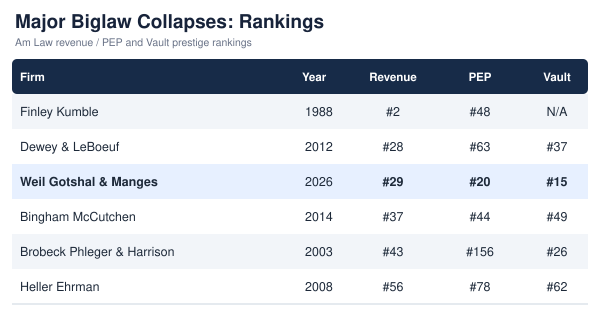
What’s the takeaway from this table? Looking at the five biggest Biglaw busts in history—plus Weil, which is likely to join their company—it’s clear that Weil stands head and shoulders above the competition when measured by a combination of profitability and prestige.
And here’s a personal, subjective data point about Weil’s prestige. Twenty-nine years ago this month, in October 1997—back when fall recruiting was actually fall recruiting, before the insanity of recruiting first-semester 1Ls—I went through on-campus interviewing at Yale Law School. Like many YLS students, I was pretty snobby, applying to just a handful of firms based largely on prestige. One of the firms I deigned to consider was Weil Gotshal:


There’s one more reason that Weil’s possible passing is striking such a chord within the legal world: It was a firm that was not only respected by its peers, but appreciated and admired by the lawyers who worked—and still work—there.
I’ve been in the legal profession for the past 30 years, counting my time in law school, and I’ve been writing about law firms for the past 20. I’ve been around for—and I’ve covered—many a law firm collapse. In my experience, no Am Law 200 firm to go under has generated the kind of emotional response inspired by Weil.9
Over the past few days, I’ve seen an outpouring of affection for Weil from its current and former lawyers and staff—and sorrow over its likely fate. Here’s an excerpt, shared with her permission, from a Facebook post by Jacqueline Haberfeld, global program director of pro bono at Kirkland & Ellis (and my former podcast guest), who worked at Weil before joining K&E:
By now you know that Weil will be winding down. I am sad for the 2,000 employees and partners, and sad for the institution itself, which started as a firm that was formed by highly-qualified Jewish lawyers when they couldn’t get into the Wall Street firms. Doing bankruptcy work, which was viewed at the time as a practice for bottom-feeders, Harvey Miller came to Weil Gotshal & Manges, transformed bankruptcy law into a highly respected area of work, and became its preeminent practitioner. (I used to say that if you asked 100 lawyers who the best litigator in the country was, you’d get 100 answers, but if you asked who the best bankruptcy lawyer was you’d only get one.)
And here’s a comment that a current Weil lawyer shared with me:
I’m not even sure what to say (although there’s certainly a lot that can be said). I think we’re all in shock because it unraveled so rapidly. What I will say is this: Weil was (is?) truly a great firm, a special place with a really great culture and outstanding people. We are all devastated.
I have no idea what I want to do next because, quite frankly, Weil is the only place I want to work. This is a profoundly sad moment for Weil and for the legal profession.
Indeed. To all the lawyers and staff affected by the turmoil at Weil, I’m sorry to see what you’re going through right now—and I wish you good luck as you figure out the next steps for your careers.10
2. Weil’s downfall was unusual: it had no debt—and it was on track for another highly profitable year in 2026.
As a historical matter, debt has played a major role in many if not most of Biglaw’s most notorious collapses. After reviewing eight pre-Dewey Biglaw failures, the late Professor Larry Ribstein observed that “[s]everal firms financed expansion with bank debt,” but “quickly failed when a business decline interacted with a credit crunch and triggering of loan covenants.” And the role of debt in Dewey’s downfall is well-documented: When the firm filed for bankruptcy in May 2012, it listed assets of $193 million and debt of $245 million, a staggering sum for a law firm.
So one factor that makes Weil stand out among failed firms is that it “has no debt and few liabilities,” as multiple sources told the WSJ. I spoke with one Weil partner yesterday, who confirmed this lack of debt—and marveled at how the firm could be going under in the absence of such financial burdens.
[UPDATE (5:32 p.m.): As reported by the WSJ’s Erin Mulvaney, Cara Lombardo, and Alexander Gladstone, one of the firm’s largest liabilities “is a roughly 380,000-square-foot lease at the General Motors Building across from Central Park in New York.” But according to real-estate experts, “the space is desirable and would likely be easy to lease again, potentially for more than Weil pays now.”]
But perhaps we shouldn’t be so shocked by a firm without debt facing difficulties. Here’s what John Morley of Yale wrote in his 2020 paper about debt and law firm collapses:
I have often heard lawyers say that the key to avoiding law firm collapse is to avoid debt. But the role of debt is subtler and less important than this simple mantra suggests. Law firms have freakishly robust capital structures, and so debt rarely drives a law firm into literal insolvency until a partner run has almost completely run its course.
He then predicted the very outcome we’re seeing with Weil (emphasis added):
In fact, it is possible to imagine a law firm collapsing even when it has no debts at all. A simple personality dispute, if it triggered a partner run, could drive a firm into oblivion even if the firm had no obligations to creditors. Debt is thus usually a symptom, rather than a cause of decline.
We might not have seen a personality dispute at Weil, but some accounts suggest that a leadership conflict, including disagreements over the direction of the firm, might have triggered the departure of Mike Aiello that was announced last month. As the WSJ wrote last month, in covering Aiello’s move:
[Aiello’s departure] comes at a sensitive time, as the firm is in the middle of a major leadership transition. Boston partner Ramona Nee is set to take over in January for longtime leader Barry Wolf, an ally of Aiello and one of his closest friends.11 While Aiello helped tap Nee, who is embracing growth, he eventually started eyeing an exit for a boutique more in line with his ethos, according to people familiar with the matter. Senior partners knew about his frustration for years.
Aiello’s departure “marked an inflection point,” as the WSJ wrote this week. It led to frenzied efforts to find a merger partner—and when those efforts failed, “confidence in Weil’s future cratered,” causing more partners to exit.12 Those additional departures led Weil to experience what Morley in his paper called a “partner run”:
Partner ownership makes a law firm fragile by exposing it to an accelerating spiral of decline that I call a partner run. Like a bank run, a partner run operates through a self-reinforcing spiral of withdrawal. When one partner leaves, she damages the firm. This causes other partners to leave, which further damages the firm, causing still more partners to leave, and so on.
And this recent partner run apparently did Weil in. As a Weil partner explained to me, the sudden, near-simultaneous loss of so many rainmakers made the firm’s cost structure—leases on offices across the globe, compensation and benefits for some 2,000 employees, and a host of other financial obligations—almost immediately untenable, even though the firm had no debt. This makes Weil’s collapse more understandable, if no less regrettable—especially since it might not have been inevitable, per this partner.
“We were—and are—incredibly profitable,” this partner said. “It’s true we weren’t increasing our profitability as rapidly as some of our peers. But we were on pace to have another massive year in 2026, with profits per equity partner possibly exceeding $6 million.”
“One of the reasons I came to Weil over other firms was that I wanted a firm that would be more stable,” the partner continued. “I thought that even if the s**t hit the fan, Weil would be safe, with one of the best bankruptcy practices in the world.”
“So here’s what I’m struggling with: If Weil isn’t safe, then what firm is safe? If we can get to this point, why not anyone else?”
3. In Biglaw in 2026, if you’re not winning, you’re losing.
This partner’s comments lead naturally into my next point: in Biglaw in 2026, if you’re not killing it, you’re getting killed. As I mentioned in my discussion of Weil last weekend, it grew its profits per equity partner by 4.13% in 2025, beating inflation. But in its peer group of the other top 20 firms ranked by PEP, everyone else notched double-digit growth in PEP last year (except for Cravath, which posted a 5.11% increase—make of that what you will).
In the 2026 Am Law 100, Weil ranked #20 in PEP—a significant drop from the 2020 Am Law 100, when it was #9. The decline reflects the fact that although Weil increased its PEP from $4.028 million in 2019 to $5.593 million in 2025, it wasn’t increasing profitability as quickly as its peers. Again quoting the WSJ (which has been doing some of the best Weil reporting, in my opinion):
The roots of the crisis at Weil date back more than a decade. The firm raked in business during the chaotic aftermath of the 2008-09 financial crisis but failed to reinvest those profits and even cut lawyers when many of its competitors were in growth mode. It has fallen behind industry leaders in head count, revenue and profit—leaving it vulnerable to poaching from rival firms.
See also this Law.com piece by Amanda O’Brien and Patrick Smith, Weil’s Journey: What the Data and the Market Say, chronicling Weil’s weakening over the years. On the one hand, it feels like Weil fell apart quickly (see point #4 below), but on the other hand, it took years for Weil to become so fragile that it could disintegrate so swiftly.
Biglaw increasingly operates through virtuous and vicious cycles. Successful firms attract rainmakers, whose books of business boost profitability, giving these firms the financial wherewithal to attract even more talent—and further increase profits. In contrast, firms that grow more slowly can experience the opposite: falling behind in profitability makes them less attractive to their top partners, whose departures further undermine the firms’ competitiveness—and make these firms ripe for partner runs.
People sometimes compare Biglaw to a shark tank, and here’s where the comparison might be accurate: Like certain species of sharks, which need to be constantly moving forward in order to survive, Biglaw firms also need to be constantly moving forward—at high speed—or else.
4. Weil’s unraveling happened with remarkable swiftness.
I was one of the principal chroniclers of the downfall of Dewey & LeBoeuf, which I followed in real time. The collective coverage that my Above the Law colleagues and I produced during Dewey’s downfall remains one of my proudest achievements in legal journalism. Dewey employees would email us to thank us for our work, telling us that they were getting more reliable information about the state of their firm from ATL than from firm management.
Dewey collapsed quickly—but its downfall still unfolded over a period of months. In February 2012, Casey Sullivan, then at The Daily Journal (and now a legal recruiter), broke the story of major financial problems at Dewey. This was followed by week after week of bad news, including layoffs and partner departures. But Dewey didn’t file for bankruptcy until May 2012, some three to four months later.
Compare Dewey’s downfall to the final unraveling of Weil—which took three to four weeks, not three to four months. While I think it’s fair to say that a number of factors, including technology and social media, have greatly accelerated the pace of change within Biglaw, I still found the speed of Weil’s downfall to be dizzying.
5. If it can happen to Weil, it can happen to anyone.
Let’s go back to what that Weil partner told me: “If Weil isn’t safe, then what firm is safe? If we can get to this point, why not anyone else?”
And here’s where I’ll raise a point that might not be popular in some quarters, but I believe is fair to ask: Maybe the fears of those Paul Weiss partners, who made their firm cut a deal in March 2025 to avoid a punitive executive order from the Trump administration, weren’t so crazy after all?
Like many observers, I criticized Paul Weiss for capitulating to an executive order that struck me as flagrantly illegal—and that four federal judges subsequently held to be unlawful. But in his firmwide email defending the agreement, then-managing partner Brad Karp argued that the EO created “an existential crisis” for Paul Weiss—and that the firm had no choice but to settle, for the sake of its clients and also “to protect the livelihoods of the 2,500 lawyers and non-legal professionals who work at Paul, Weiss.”
Karp’s “I did it for the janitors” defense of his deal with the Donald was met with many eye-rolls (or worse). A common response went something like this: “No, Brad, you did it to protect your profits per partner—the millions of dollars that you and your fellow partners are taking home each year. Rather than risk the possibility of Paul Weiss’s profits per equity partner declining—from $7.5 million a year in 2024 to, say, $5 million a year, heaven forfend—you and your partners bent the knee to authoritarianism.”
But Weil’s collapse illustrates how quickly an apparently healthy, highly profitable law firm can unravel entirely, as long as enough partners lose confidence and depart. Perhaps Karp’s fears about the firm’s survival weren’t completely unfounded. (See also my April 2025 story, Trump Executive Orders Expose—And Exploit—Biglaw Vulnerability.)
Now, it’s a totally legitimate position to say, “Fiat justitia ruat caelum”—“Let justice be done though the heavens fall.” Or put another way, “It’s better to die on your feet than to live on your knees.” A person with this worldview would argue that the Paul Weiss partners should have done the moral and ethical thing, even if the firm would have collapsed. And the vast majority of PW partners would have been fine. They—and their books of business—would have been welcomed at any number of rival firms (although associates and staff might have faced more challenges).
Now, please don’t misunderstand me: I’m not arguing that what just happened to Weil means Paul Weiss was right to settle. And, of course, the four firms that are bravely fighting the administration in court all remain in business (although none of them is as heavily dependent on transactional work as Paul Weiss). Instead, as a critic of the deals myself, I’m raising a possibility for our honest consideration: The costs of courage might be higher than we realized—which might make it more understandable when people surrender, as well as more commendable when they fight on.
Okay, I should stop here; I’ve gone on far too long, and it’s time to publish (lest this post get overtaken by even more events). I’ll just close by saying once again, to everyone affected by what’s going on at Weil, that I’m thinking of you and pulling for you—and wishing you the best of luck as you navigate the road ahead.
[UPDATE (10/30/2026, 12:48 p.m.): Since it appears that folks are continuing to read this post and remain keenly interested in the topic, here’s some additional recommended reading (with highlights from each piece):
The Five Whirlwind Days That Brought Down Weil Gotshal (gift link), by Erin Mulvaney, Cara Lombardo, Corinne Ramey, and Jasmine Li, for The Wall Street Journal
“Some people internally and externally blame its longtime leader, [executive partner and chair Barry] Wolf, for failing to make the same decisive moves as rivals such as Kirkland & Ellis and Paul Weiss, including reinvesting profits from the financial crisis to poach top talent. Wolf, 66 years old, eschewed client work for years once he took over running the firm in 2010.”
“Others lay the blame with Michael Aiello, the firm’s top dealmaker and a polarizing figure who some say made it harder to recruit for other practice groups that might create conflicts with his work.”
“[T]he firm was financially healthy. It was among the 20 most profitable firms in the industry, and the firm has well more than $1 billion receivables and work in progress that has yet to be paid.”
“Wolf and Aiello were the two best-paid partners at the firm, earning north of $20 million a year each. Their fortunes were linked: the size of Wolf’s paycheck was due to a unique provision ensuring that as the firm’s leader he was paid the same as the highest-earning partner each year.”
“Aiello broke the news [of his group’s move to Cravath] to Wolf in early September shortly before Rosh Hashanah. It was the last time the longtime friends spoke.”
What killed Weil Gotshal? (gift link), by Kaye Wiggins, Oliver Barnes, Sujeet Indap, and Amelia Pollard, for The Financial Times
“On Wednesday afternoon, Weil, Gotshal & Manges’ management committee gathered in a conference room on the 25th floor of Manhattan’s General Motors Building, where the elite law firm has been based for nearly 60 years. They were there to deliver news that would have been unthinkable just weeks earlier.”
“Going into the meeting, partners did not know what verdict had been reached. Some in the room began to cry. [After announcing the recommendation of a wind-down to the firm’s lawyers over Zoom,] Weil’s leaders did not take questions.”
“Soon after [news of the departures of Christopher Machera to Paul Weiss and Brian Parness to Simpson Thacher] came the biggest blow: Aiello’s plans to leave for Cravath, taking a group of M&A partners with him. Together with his team, Aiello had been responsible for between $100mn and $150mn of revenue a year—roughly 5-7 per cent of the firm’s total. Machera, Parness and their teams accounted for a further $100mn or so.”
“Last year, Weil set up a six-person “global leadership and strategy committee” to focus on how to make it fit for the future. By last week, three of the six—Aiello, Machera and [litigation partner Chantale] Fiebig—had announced their departures.”
“Since Wednesday’s announcement, shock has given way to anger for some current and former lawyers of the firm. Several floated the idea that Weil’s leadership could face a lawsuit over strategic blunders in recent years. Others pinned Weil’s demise on Aiello and others for abandoning ship, and on Nee for walking away from her duties. Others disagree. ‘Ramona worked around the clock and tried to do everything she could to have a viable firm going forward,’ one Weil partner said.”
Run on the Law Firm (gift link), by Matt Levine for Bloomberg Opinion
Explaining how a partner run works: “If twenty $50-million-a-year partners leave, the firm will be down to $1 billion of revenue [from $2 billion], $600 million of fixed costs, and only $400 million of profits to share among its 230 remaining partners, or just $1.7 million per partner, which will barely cover their kids’ private school tuitions. That is a disaster case for any partner still left at the firm.”
“If you [are a $5-million-a-year partner and] think 20 rainmakers might leave, you will be sending out your resume, because: (1) You see this dynamic starting and know that, the more rainmakers who leave, the more rainmakers will leave. (2) You don’t want to be left at the firm after the rainmakers leave, because it will no longer be profitable enough for your kids’ tuitions. (3) You don’t want to be left at the firm after the rainmakers leave, because whoever’s left will be stuck with all of the firm’s various fixed costs…. So everyone sends out their resumes at the first sign of trouble, the end.”
“AI will, probably, change [the Biglaw business model], somehow. There are various possibilities, of which one is of course ‘clients will just ask AI for legal advice and stop using law firms altogether.’ But another possibility is that law firms will use AI to increase their operating leverage. Some big law firms will invest a lot of money in AI systems to, like, do all the work of associates; at those law firms, a partner who brings in $50 million of revenue can keep $49 million for herself, because her only costs will be some tokens. Other firms will keep doing things the old-fashioned way and lose their rainmakers to the more AI-forward firms. And other firms will invest a lot of money in AI systems but then lose their rainmaking partners anyway to firms that do it better, leaving them with huge fixed costs and even worse partner runs. I’m not sure that Weil is exactly an example of any of this, but that may be the future.”]
[UPDATE (11/2/2026, 6:33 p.m.): For additional discussion of Weil, see my latest weekly legal news roundup, Judicial Notice (11.01.26): Who Killed Weil Gotshal?]
Weil was founded in New York City in 1931 by Frank Weil, Sylvan Gotshal, and Horace Manges. This makes it the rare Biglaw firm where the founders’ names are still on the door, as well as a firm whose name hasn’t gone through a dozen different iterations.
Even Cravath Swaine & Moore, which many of us think of as the ur-firm of Biglaw, can’t claim such stability. The firm was founded in 1819 by Richard Blatchford, whose name is no longer on the marquee; Paul Cravath, who developed the “Cravath system” that became the Biglaw blueprint, didn’t join the firm until 1899, some 80 years later.
My quick online research wasn’t able to unearth much about Frank Weil, Sylvan Gotshal, and Horace Manges as individuals (although they all garnered New York Times obituaries—here, here, and here—which is, in my book, a sign of a consequential life). But I did learn that they were all Jewish graduates of Columbia Law School—and as noted on Weil’s Vault page, they “founded Weil after many doors were closed to them simply because they were Jewish.” So Weil’s origin story is similar to that of my former firm, Wachtell Lipton Rosen & Katz, which was founded in 1965 by four Jewish graduates of NYU Law School who similarly faced antisemitism at the established, white-shoe firms.
As for how to pronounce “Weil Gotshal & Manges,” it’s “WILE GOT-tchyal and MAN-jeez.” See Lat’s Law Firm Pronunciation Guide (which also notes the firm’s humorous nickname, “We’ll Getcha & Mangle Ya”).
No date was provided for the group’s departure from Weil or arrival at Cravath. In fact, as of this writing, Mike Aiello and the other members of his team remain on the Weil website.
In December 2020, Boies Schiller was practically left for dead by many observers, with a fair number of folks predicting that it wouldn’t last a year. I won a bet taking the other side of that proposition—and almost six years later, BSF is still around.
Fun fact: one of the Weil defectors was Yvette Ostolaza, now chair of the management committee at Sidley Austin.
I’ve witnessed enough Biglaw busts to make me fairly vigilant. For names of some of the biggest Biglaw collapses of the past 40 years, check out my X post and the replies thereto.
I listed several significant partner departures in last Sunday’s Judicial Notice post, involving partners in leadership roles at Weil: Michael Hickey, Lyuba Goltser, Andrew “Drew” Tulumello, Chantale Fiebig, and Caroline Zalka.
Since then, additional departures have become public. Doug Warner, Weil’s global co-head of private equity, is pushing off for Paul Weiss. And two Weil lawyers who previously worked at the Securities and Exchange Commission, Andrew Dean and Christopher Mulligan, are skedaddling to Skadden Arps—in New York and D.C., respectively.
In theory, because Weil remains a going concern, it could still merge with another firm—and if this were a Hollywood movie, maybe some white knight would show up around now. But in light of the fact that Weil’s merger talks with Vinson & Elkins and Willkie Farr didn’t go anywhere, and there appear to be no other potential partners on the horizon, it seems that we should expect a wind-down followed by a dissolution.
The Vault prestige rankings didn’t exist when Finley Kumble was around—but if they had, they wouldn’t have been kind to the firm. From The New York Times:
[T]he firm picked up a reputation as a greedy bunch of aggressive lawyers bound by love of money, rather than by the traditional concepts of collegiality, loyalty and professionalism. Finley, Kumble has been called everything from “a franchise operation” by Milton Gould, one of the grand old leaders of New York’s Shea & Gould, to a “monstrosity” by Norman Roy Grutman, a former Finley, Kumble partner who left in 1976 because of differences over the direction the firm was taking.
For funsies, I asked ChatGPT to guesstimate Finley Kumble’s Vault 100 rank, if the Vault 100 had existed in 1987—and it came up with a range of #30-#50. For an entire book about the dumpster fire that was Finley Kumble, see Kim Isaac Eisler’s Shark Tank: Greed, Politics, And The Collapse Of Finley Kumble, One Of America’s Largest Law Firms.
As for Weil’s prestige, its current rank of #15 doesn’t even represent its peak. The firm climbed as high as #6, in the 2014 Vault 100—so it was, at one point, a top ten shop.
I should offer the caveat that this might not be an apples-to-apples comparison, since Weil’s crisis is unfolding in the age of social media, and many of the responses I’ve seen have been on LinkedIn, Facebook, and X. It’s possible that some of the firms that fell apart in ages past might have generated similar public reactions if their employees and alumni had had the same level of access to social media enjoyed by Weil folks today.
One of the arguments in favor of an orderly wind-down—as opposed to trying to “hang in there” but risking a more precipitous collapse, including a possible eleventh-hour bankruptcy filing—is that a gradual wind-down will provide lawyers and staff with a more stable and smoother transition, including greater certainty about their near-term financial futures. One source told Reuters that Weil’s associates and staff have been told that they will continue to receive pay for 90 days—and even receive bonuses at the end of 2026.
When we learned last weekend that Ramona Nee would not be assuming the role of executive partner in January, as originally planned, that was a bad sign for the firm’s future. In my coverage of that news, I wrote that Nee “recently decided not to take the reins.” But was I wrong about the “recently decided” part?
One source told me, “Apparently, the rank-and-file partners didn’t find out until last weekend that Ramona Nee had decided not to take over as executive partner, even though word is that she told Barry and the management committee in late August/early September. That means the partners didn’t know for two months—and there was no one else teed up for the role.” (I reached out to Weil to see if the firm might have any comment on this claim, but I did not hear back.) [UPDATE (5:32 p.m.): This was actually in Lauren Hirsch’s Times piece, and I somehow missed it: “in August, Ms. Nee told the firm’s management that she would turn down the top role, the two people said. Many partners learned of Ms. Nee’s decision [only] this week.”]
For folks who have been comparing the Weil collapse to Dewey, the move of the Aiello group is the closest analog Weil has to the departure of Alexander Dye’s insurance group for Willkie, which many view as the pulling of a thread that led to the unraveling of Dewey & LeBoeuf.
Thanks for reading Original Jurisdiction, and thanks to my paid subscribers for making this publication possible. Subscribers get (1) access to Judicial Notice, my time-saving weekly roundup of the most notable news in the legal world; (2) additional stories reserved for paid subscribers; and (3) the ability to comment on posts. You can email me at davidlat@substack.com with questions or comments, and you can share this post or subscribe using the buttons below.
Hard to square this outcome with all the comments about a great culture.
Do you know why the merger talks fell through? It would seem attractive to me, given, as you point out, no real debt and a lot of equity per partner. (I’m far beyond my wheelhouse here.)