


Welcome to Original Jurisdiction, the latest legal publication by me, David Lat. You can learn more about Original Jurisdiction by reading its About page, and you can email me at davidlat@substack.com. This is a reader-supported publication; you can subscribe by clicking here.
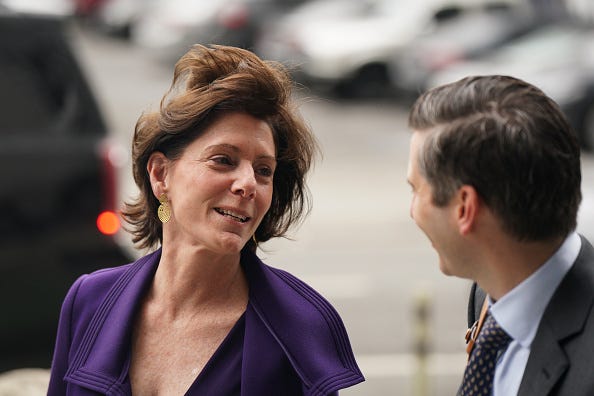
Veterans Day was last week, so it was very fitting that I interviewed Beth Wilkinson, one of the nation’s top trial lawyers and founding partner of Wilkinson Stekloff. After graduating from Princeton and UVA Law, she began her career as a lawyer in the Army JAG Corps. She then continued her public service by working as a federal prosecutor, where she successfully prosecuted the Oklahoma City bombers.
Over the decades, Beth has handled—and won—many other consequential cases. Earlier this year, she led the trial team that secured judgment as a matter of law for the NFL in the multibillion-dollar Sunday Ticket litigation. Last year, she served as lead trial counsel for Microsoft in the FTC’s challenge to Microsoft’s acquisition of Activision—and her victory allowed that $68.7 billion deal to go through. And she shows no signs of slowing down: she was recently retained by Visa to defend the payments giant in a bet-the-company antitrust case.
Thanks to Beth for joining me to discuss her fascinating career and cases—and, of course, for her many years of service to our nation.
Show Notes:
Beth Wilkinson bio, Wilkinson Stekloff
Beth Wilkinson bio, Wikipedia
Beth Wilkinson profile, Chambers and Partners
Prefer reading to listening? For paid subscribers, a transcript of the entire episode appears below.
Sponsored by:

NexFirm helps Biglaw attorneys become founding partners. To learn more about how NexFirm can help you launch your firm, call 212-292-1000 or email careerdevelopment at nexfirm dot com.
Three quick notes. First, this transcript has been cleaned up from the audio in ways that don’t alter substance—e.g., by deleting verbal filler or adding a word here or there to clarify meaning. Second, my interviewee has not reviewed this transcript, and any transcription errors are mine. Third, because of length constraints, this newsletter may be truncated in email; to view the entire post, simply click on “View entire message” in your email app.
David Lat: Welcome to the Original Jurisdiction podcast. I’m your host David Lat, author of a Substack newsletter about law and the legal profession also named Original Jurisdiction, which you can read and subscribe to at davidlat dot Substack dot com. You’re listening to the sixtieth episode of this podcast, recorded on Tuesday, November 12.
Thanks to this podcast’s sponsor, NexFirm. NexFirm helps Biglaw attorneys become founding partners. To learn more about how NexFirm can help you launch your firm, call 212-292-1000 or email careerdevelopment at nexfirm dot com. Want to know who the guest will be for the next Original Jurisdiction podcast? Follow NexFirm on LinkedIn for a preview.
Monday, November 11, was Veterans Day. So it was very apropos that on Tuesday, November 12, I interviewed Beth Wilkinson, founding partner of Wilkinson Stekloff, a leading litigation boutique. After graduating from UVA Law, Beth joined the Army JAG Corps, where she served at the rank of captain and worked on the prosecution of Panamanian military leader Manuel Noriega.
After her time in the Army, Beth continued her record of service by becoming an assistant U.S. attorney. During her time at the Justice Department, she successfully prosecuted Timothy McVeigh and Terry Nichols for the 1995 Oklahoma City bombing, among other notable matters.
So Beth is a veteran not just of the military, but of trial practice. As one of the nation’s top trial lawyers, she has served as lead counsel in over 50 jury trials. Two of her major victories in the past two years include securing judgment as a matter of law for the NFL in the multibillion-dollar Sunday Ticket litigation, and scoring an epic win for Microsoft in its litigation against the Federal Trade Commission—which allowed Microsoft’s almost $70 billion acquisition of Activision to proceed. Without further ado, here’s my conversation with Beth Wilkinson.
Beth, thank you so much for joining me.
Beth Wilkinson: Thank you for having me, David.
DL: So tell us about your background and upbringing. Where did you grow up?
BW: I grew up most of the time in rural Connecticut near Groton, which is where the United States’ largest submarine base is, and my dad was a nuclear submarine officer and captain. I went to public school there in Ledyard, Connecticut, and then went on to college. So I grew up in a community where most people’s parents were either farmers, military and Navy folks, or scientists at Pfizer—there’s a little R&D lab in town.
DL: Well, I would like to point this out to any of my readers who are Wikipedia editors: Beth’s entry erroneously states that she grew up in Washington State. So if someone can please fix that, you can cite this interview as your authority.
Did you have any lawyers in the family or exposure to law growing up, with your father working on submarines?
BW: Not really. I had one friend in high school whose dad was a solo practitioner, so I think I had met one lawyer before, really, law school. Maybe in college one of my friends had a parent that was a lawyer, but not that I recall. I’m far older than you, and there weren’t that many women lawyers back then, so I don’t remember meeting almost any lawyers before I went to law school.
DL: When you were at Princeton, did you study something in the legal realm? Did you study politics, poli-sci, something like that?
BW: I did. I studied politics. It was really political theory, so it had nothing to do with law. You know how some people take those undergraduate law courses? I took none of those, and I didn’t do the debating society either.
DL: So no debate, no pre-law-type courses. What led you to decide to go to law school?
BW: My story is kind of pathetic. I was a huge TV watcher as a kid, and I loved Perry Mason, and of course I thought everyone was innocent and I would be defending people wrongly accused of crimes. And that’s what I wanted to do.
DL: Interesting—although you haven’t done a huge amount of criminal defense work in your career, have you? I know you’ve worked as a prosecutor and a civil defense lawyer.
BW: I have not. I’ve done some—one major case, and it was very difficult. Trying the case was wonderful, but it’s very hard watching the government use its overwhelming resources against an individual, and my hat goes off to the people who do criminal defense work every day. It is really difficult. My partner Brian Stekloff was a public defender, and he’s a magnificent trial lawyer and cross-examiner, and when you hear his stories, you understand how important their work is, but how difficult it is.
DL: I absolutely agree with you. My last guest, Alexandra Shapiro, has done a lot of criminal defense work.
BW: I know her; I was partners with her at Latham. She’s a phenomenal lawyer.
DL: Yes. She’s amazing.
So when you went to UVA Law School, did you think then that you were going to go into criminal-defense work?
BW: No, because I had been in ROTC at Princeton to pay for college, so I owed the Army four years. I took a delay to go to law school, and so I knew I would serve in the Army. So I could have done criminal defense there. But I was selected for an honors program where I worked in the Pentagon on intelligence, special operations, and national security work, for the Secretary of the Army.
DL: And this was after college or law school?
BW: After law school. My first four years practicing law was as an assistant to the general counsel of the Army.
DL: So it’s interesting you joined the JAG Corps. A lot of people associate that with lots of trials, but it sounds like your work was much more advisory or counseling?
BW: Exactly. I didn’t do any trials when I was in the honors program, because while I was technically JAG, I was really assigned to military intelligence. I didn’t even wear a uniform at the Pentagon. It was in a civilian capacity, even though I was on active duty as a captain. So I never did a trial until while I was on detail there down to Miami, during the Manuel Noriega case, and they let me do some trials down there.
DL: And you actually did work on the Noriega matter or some part of it, right?
BW: I did. I was such a junior lawyer then—really I was just helping with the declassification of the documents because Noriega had been a spy for the Army, and so we had to declassify documents. But because there was a delay in the case, the U.S. Attorney’s Office there, which is wonderful, allowed me to try three cases when I was down there for six months. So I had a lot of trial experience under the good tutelage of some excellent prosecutors.
DL: So you did get a good amount of trial experience, especially for somebody only four or fewer years out of law school then?
BW: I did. Looking back on it now, I see how difficult it is for people to get trial experience at a young age. Yes, I was very lucky.
DL: And so were you bitten by the trial-lawyer bug at that point?
BW: I always wanted to be a trial lawyer. Like I said, I thought I was going to be standing up in court and defending people accused of crime. So I always wanted to be in the U.S. Attorney’s Office, and that’s what I did. I applied to the U.S. Attorney’s Office as I was finishing my time at the Pentagon.
DL: Before we get to the U.S. Attorney’s Office, I am curious—we are recording this a day after Veterans Day, so thank you for your service—has your military service and background influenced your lawyering in any way? Did you take away any lessons from your time at the Pentagon or in Florida that you have used in the years since?
BW: I certainly think it has. I grew up in a military family, so it’s hard to even separate that. I think I’ve definitely learned that when you’re captain of the ship, you’re responsible for everything, and you never, never blame the people below you. That’s definitely a tenet of our firm here. And clarifying those responsibilities I think is very important in any work, but obviously in trial work.
I think of being a good leader—although I’m sure I’m a very flawed one—and having integrity, which is a huge value in the military that I think I bring to my work. But I think a lot of people bring that without serving. I do feel like it was also a great way for a young woman to learn to work in a predominantly male environment—and again, as a person a bit older than probably most of your listeners, that was an important development for me, and I was very lucky to get that benefit.
DL: Your point about accountability is a very important one. The military is excellent about that, in terms of leaders being accountable. Unfortunately in law, sometimes senior people throw junior people under the bus.
But you mentioned the U.S. Attorney’s Office, which is where you went after your time in the military. Tell us about your time as an assistant U.S. attorney.
BW: I loved it. I worked in the Eastern District of New York with everyone from Valerie Caproni, who’s on the Southern District of New York bench, to Beryl Howell, a judge here in D.C., to Loretta Lynch, who became the attorney general, to Leslie Caldwell. I worked with a phenomenal group of people—but in that time period, just again, I was so lucky to work with these, as I like to call them, “badass women,” who were phenomenal trial lawyers and great people.
I tried all kinds of cases, and it was just a wonderful experience. I learned so much. And I wasn’t very good when I started, and I think I got a lot better. I hope I’ve improved every year since then. But it really was a place where you could learn and make mistakes, even though you had a lot of responsibility—or because you had a lot of responsibility.
DL: The Eastern District of New York of course includes Brooklyn—but you also did some interesting work on matters not in Brooklyn.
BW: Yes, I was on a detail down to Washington, D.C., where Merrick Garland was my direct boss, and Jamie Gorelick, the deputy attorney general, was my ultimate boss, along with Janet Reno. So I was brought down there to work on some issues for them. And then in April of 1995, the Oklahoma City Murrah Building was bombed, and eventually I was assigned to work on that trial.
DL: Tell us about that. That must’ve been a very difficult experience.
BW: It was. I was not a mother at that time, which made it much easier for many reasons. I could be away from home for two years—which I was, on and off, the whole time—and I was devoted to the case, like everybody else was. It was an amazing experience and an honor to serve and to learn. I was a young lawyer, and Joe Hartzler, who was the lead prosecutor, taught me more about trying cases than anyone I’ve ever met. He’s really a gifted trial lawyer and had been a prosecutor, but also a defense attorney—so he had a better perspective, I think, than many of us did who were just prosecutors. I got a lot of responsibility, and I got to speak to the victims and the survivors. So that gave me a whole new perspective on trial and what it does to people.
And then, of course, it was of huge importance to the country, and there was incredible media attention. So everything about it was fascinating. I did my first, I would say, substantive cross-examination in that trial, which is kind of a big stage to do it on. But it was a wonderful experience, and I’ll always be grateful to the other lawyers for giving me those opportunities, and the attorney general and the people back in Washington who didn’t micromanage the case, but they surely approved me going out there. And I think if they didn’t want Joe giving us opportunities, they might’ve made that clear to him.
DL: You mentioned that at that time you were not a mother, which made it easier in a number of respects. As I recall, a number of the victims of that bombing were children.
BW: Nineteen children were killed in that bombing. And there were two trials, as you know, Timothy McVeigh and Terry Nichols—the cases were severed. There was a multiple-day, three-day penalty phase, after the guilt phase—and that was the most difficult thing I’ve ever done.
We each put on witnesses, and when I put on my witness, I had been with the witness the night before and the day before, prepping them, and probably more than once was teary-eyed. So when I got up to put my witness on, I knew what was coming—but when other people put their witnesses on, I didn’t. And it was very difficult to maintain your stoic face—which the judge had made clear we needed to do, and of course he was right—and everybody was just emotionally torn up. After every break, you would see the reporters even calling their families. And if I run into people who were there, even today, we all share that experience, how painful it was to listen to these parents and mothers and grandparents or children who lost their mothers. We heard every story. And it really was a great prep for private practice, because I saw people show such grace under the most difficult circumstances—so when I got into private practice, and it was about money, I was like, “Whatever—I’ll sleep well.”
DL: That case did have the highest stakes possible because it was a death-penalty case, and you successfully argued for a death sentence for Timothy McVeigh. But you have also served as co-chair of the Committee to Reform the Death Penalty, which is a nonpartisan group seeking reforms of capital punishment. What are your views on the death penalty? And have they evolved over the years, or have they been consistent?
BW: I think they’ve been consistent. I’ve been a very reluctant supporter of the death penalty—that’s how I would describe it. I would say my parents were not supporters, and I grew up in a very devout Christian family—progressive, but devout—so I think it was difficult for me. And that case was easier because, if you are going to have the death penalty in the United States, a federal case where 168 people and 19 children were killed—this is the case for it. So I got comfortable with it, and I hope that in terms of my feelings about it, I hope I was more sensitive to what we were asking the jury to do, because I saw the complexities. Generally, I think it has not been administered fairly in the United States (as most of those cases happened in the States). So that’s why I was eager, when they asked me, to join the board of the Constitution Project’s Death Penalty Committee, and why I testified in Congress about the real problems with the death penalty.
DL: No, absolutely. I think that even people like yourself, who do support the death penalty under appropriate circumstances, agree that it’s really terribly administered.
So was that one of your last major matters at the Justice Department? How much longer at DOJ were you after those trials?
BW: I stayed only a few months. I really didn’t go back to the U.S. Attorney’s Office. After that, I think I felt that to improve my skills as a lawyer and to get away a bit from the emotion of those cases, it was time for me to go into private practice. Of course, at that time I thought, “Oh, I’m not going to like it—I’ll just go for a few years and make some money.” And that was about 30 years ago.
DL: You mentioned Latham earlier. Is that when you went to Latham & Watkins?
BW: Yes. That was fortuitous and lucky, and I learned many things, but I learned a lot about private practice and handling clients and the business of private practice, from the very bright and interesting lawyers that I met at Latham. I’m still friends with many of them.
DL: Which office were you in?
BW: I was here in D.C., which was about 75 people at the time. I think it’s now over 300.
DL: And what was your docket at Latham? Was it mostly complex commercial litigation? It was trial work, I’m assuming, rather than appellate? Because Latham has always had a great appellate practice as well. What was the mix of your cases there?
BW: It was trial-focused, and there were commercial cases or product liability cases, but mostly trial. My first trial was a trial Mike Chertoff was supposed to do, and he went into the government, and I got to do it. That was settled two weeks into the trial. My first completed trial was the first civil trial I had ever seen, so I was actually leading the first trial. I’d never seen one because I didn’t clerk (because of the Army). So I was able to learn all kinds of things there, and I was lucky enough to be there when Maureen Mahoney was, who was the leader of the appellate practice and one of the stars of the Supreme Court bar then—and I think forever.
So they had a great philosophy. They didn’t want me to just go do any case. They wanted me to do cases that would actually contribute to my portfolio and teach me about how to be a better lawyer in private practice, and I’m grateful for that. So I did get trials, but it wasn’t like they just put me on any old case. And I ended up also early on defending the Salt Lake City Organizing Committee [for the Olympic and Paralympic Winter Games of 2002] in the bribery scandal. So that was a criminal case, and I developed my fondness and long-term ties with Utah being out there defending the Organizing Committee.
DL: That sounds great. And definitely people have said very positive things about Latham—both people who are currently there, including some of my past guests, and also people who are no longer there but are alumni. So where did you go after Latham?
BW: Well, I had three very small children when I left, and my husband said, “we need to slow down”—which is code for “you need to slow down.” So the CEO of Fannie Mae called me and said, “Would you like to apply to be general counsel?” And Fannie Mae was right down the street. So I did, and I got the job, and I went there to be general counsel. I thought I would have more flexibility, less travel—which was true, a lot less travel—and be able to spend more time with my family and still have a very interesting job. I was sad to leave trial work, but we all make choices at different times, and three small children under three at the time focuses the mind.
DL: That must have been challenging though for you in the sense that as GC, you probably were not on your feet arguing in front of judges and juries, which clearly you love to do.
BW: I was not. You use those same skills of persuasion, I hope, with management and the board—and I enjoyed talking to the board.
I was a terrible client. I went once to court and sat in the back with a partner from Latham, whom I had hired and whom I greatly admire, and I was sending notes and whispering—exactly what you don’t want clients to do. So I never went back to a courtroom while I was at Fannie Mae. That wasn’t my job.
And it was very interesting being involved with the business side. So I did miss it, but I also learned so much more, and I think it made me a better lawyer when I came back to private practice because I understood in-house people, what their needs are, what their clients are looking for, and it’s quite different sometimes than you think when you’re knee-deep in an individual case on behalf of a client as outside counsel.
DL: So would you say that you actually enjoyed your time as an in-house lawyer?
BW: I did. I really enjoyed it. It was humbling. I don’t think I was the best at it. I think there are other people who are much better at it. But I felt like it was challenging and interesting. And Fannie Mae went through a real crisis during the housing disaster in 2007 and 2008 and 2009—and so that was fascinating, to be part of that and be giving advice daily on issues that really no one had ever encountered, at least at Fannie Mae. But I was happy to go back to trial work.
But I wouldn’t change anything. I wouldn’t change going there.
DL: If you enjoyed it—and certainly you’ve alluded to a lot that you learned there, and a lot that helped you become a better lawyer—that’s great. So what led you then to return to private practice?
BW: Well, the government took over Fannie Mae, as you may recall—so you were really working for the government, and that was not what I had signed up for. So I decided to go back out into private practice, and that’s when I ended up at Paul Weiss in D.C.
DL: Tell us about your time at Paul Weiss. I think in some ways that was a very visible part of your career. I think when people think of Beth Wilkinson in Biglaw, they think of your time at Paul Weiss.
BW: Definitely. It was a great platform. I had some clients of my own, and the firm was really supportive. And Biglaw changes all the time. At that time, Paul Weiss was one of the premier big firms that still focused on litigation and trial work—they had more of a boutique corporate practice, that’s changed since then—so I was really attracted to that.
And then my buddy Ted Wells was there, and he is one of the best trial lawyers ever. And so I was drawn to the ability to get to work with him, or at least be partners with him, and be part of a firm that has such a great history in litigation, trial work, and pro bono work—the contributions they’ve made to our country through their pro bono work, I really think that it’s hard to find a firm that’s done better. So it was very nice to join them.
DL: That’s so true, and in many ways your profile fits that of many of the great Paul Weiss lawyers. One of my past guests, Secretary Jeh Johnson, talked about how Paul Weiss lawyers have served in government and gone to private practice and served in government again and gone to private practice. I think that’s a great tradition that in some ways I feel is becoming less common. So, that’s great. What types of matters did you work on during your time at Paul Weiss?
BW: I did a little of everything. I worked on tobacco class-action cases for Altria, I worked on product-liability cases for Pfizer, I did a securities-fraud case, I did a Major League Baseball antitrust case, I had an antitrust case for Georgia Pacific—kind of across the board, which is what I like, all different kinds of litigation. I had some criminal investigations. I defended Hillary Clinton’s people in the email scandal—that started when I was at Paul Weiss. I had a very broad portfolio.
DL: And now a word from our sponsor, NexFirm. In 2016, Beth Wilkinson left the partnership of Paul Weiss to start her own boutique firm, and almost nine years later, she has no regrets. Freed from the constraints of Biglaw, she enjoys greater flexibility in terms of what matters she works on, how she bills her clients, and so much more. Are you interested in following in Beth’s footsteps by leaving Biglaw to launch your own firm? For a complimentary consultation about whether it might make sense for you and your practice, as well as advice if you decide to go for it, reach out to NexFirm by calling 212-292-1000 or email careerdevelopment at NexFirm dot com. You’ll be glad you did.
So it’s interesting: you mentioned two areas that I think in some ways you are known for, even though I think first and foremost you’re known as a trial lawyer, and in some ways perhaps you’re agnostic in terms of the subject of the trial. But one area of law that I think many of us associate with you is sports law, because you’ve carved out this niche as a sports litigator over the years, representing the NFL and Major League Baseball and the Organizing Committee and other sports clients. Was that intentional? How did that happen?
BW: Based on my brilliant knowledge of sports, David—I can’t believe you wouldn’t guess that!
I think it was fortuitous. For the Olympics, I was put on that case because I had some related experience before that, but it was not really direct. And then at Paul Weiss, I ended up working for the NFL—which was their client, not a client that I had brought in myself—and I was on the concussion case. So I started there, where you would think the product-liability skills that I might’ve gained from those trials would be useful, even though those cases ended up settling.
And then I got a call out of the blue—really it started with Fox, when they owned all the regional sports networks, to do an antitrust case in front of Judge Shira Scheindlin. And then the general counsel there conspired with the commissioner of Major League Baseball to move me into the lead position—I’ll always be grateful to him for that. And so that happened there, and then the NCAA called me, and we’ve done an extraordinary amount of work for them. It was nothing I would’ve thought I would ever be focused on, but it’s been fascinating and fun. I love to go to NFL games now. I love basketball, although I’ve never done work for the NBA. So it’s been great for me, and my kids think I’m cool for it. It’s about the only thing they think about my work that’s cool.
DL: So when you referred to your knowledge of sports, people can’t see this on Zoom, but you did so with a smile. So I wasn’t sure if that was sort of tongue in cheek—but it sounds like you are quite a sports fan.
BW: I’ve become one because I have three athletic children. But I knew nothing. I was a dancer and in ROTC, like I said, in college. I never played a sport. I was never good at any sports. I watched them to be with my dad, like a lot of people when they’re growing up. But I have learned a lot with three kids who love sports and a husband who loves it, and I’ve really enjoyed it. Even now that my kids are out of the house, I still enjoy watching and going to live sporting events. I just went to the Commanders game a couple days ago; it was heartbreaking, but wonderful.
DL: That’s great. A lot of times clients will say, “We want a lawyer who understands our world and understands our business.” And I guess with all your sports clients, you’ve been understanding their world and business.
So in some ways you had a great setup at Paul Weiss. It’s an amazing firm. With all this support, you could focus on practicing law and trying cases. So why would you leave such a storied firm and start your own firm?
BW: You’re not the first person to ask me that question because it is a wonderful firm, and I was treated very well there. So there are really two reasons. One is I thought I had a different business model that might work. In Biglaw, as you get more senior and you’re more knowledgeable, you’re more efficient—but you still have to bill a lot of hours to make it worthwhile for the firm. And that didn’t seem to make much sense to me, and especially as a mother who wanted to be able to do both; I wanted some reward for being efficient. I had tried, and Paul Weiss had let me do, a couple of fixed-fee trials, and they worked out really well. So I thought it would be great to be able to do that all the time. I certainly didn’t want to discount my fees when I did trials, which big firms sometimes need to do for their clients.
And then I think I thought, I was in my early 50s, and I just wanted a new challenge. And for all the strengths Paul Weiss had, turning that ship in a way that you might want—it’s not my firm, I can’t do that.
With a new firm, we could start from scratch. And diversity of opportunity, diversity of personnel, was very, very important to me. I wanted to show that we could get the biggest cases and still be rewarded financially for that, but have a very diverse work group—and that’s turned out to be true. And so it’s easier to do when you started your firm nine years ago than when you started your firm 100 years ago.
DL: Absolutely. Being able to have your own firm means that you can reimagine everything—you’re not trapped by inertia or just institutional ways.
BW: You can make your own mistakes, that’s for sure. You definitely make a lot of mistakes.
DL: And learn from them. But you alluded of course to billing, which I think is one reason people leave large firms to start their own firms—they have greater flexibility, and they can come up with different arrangements. So I understand that Wilkinson Stekloff has a somewhat different approach to billing, at least compared to say the Paul Weisses of the world. Can you tell us about that?
BW: We have a different approach to billing than almost any other firm. I only know of one or two firms who do what we do. We have no internal billing, so people don’t have to account for their time and we don’t bill to clients. We agree with clients when we start how much we’re going to charge per month in different phases of the case; there’s lots of permutations to that. But people would refer to that as either a fixed fee or alternative fee. It’s not a budget. It’s not a cap. If they’re going to pay us X for this month, that’s what they pay, no matter how much work we end up doing. I wasn’t sure how successful it would be, but it has turned out to be a wonderful model, because clients can go to their finance department and say, “This is how much this is going to cost”—and that’s how much it costs. There’s no back and forth with the in-house people having to review your bills and saying, “Why did you put 8.2 hours or two associates on it?”
And for associate development, it’s been incredible, because when we bring more people into a meeting, the assistant general counsel or the general counsel isn’t going, “Oh, that person just cost me $1,000 more an hour.” So if I say, “Oh, I have another partner who’s coming in, Moira Penza is going to come in,” they think, “Great, I get another partner ‘for free’—which of course is not exactly accurate.” And when younger associates are in meetings, clients don’t mind, and the associates learn a lot. Obviously we encourage people to speak up, and they get a lot more exposure to clients. So we have a partner, for example, who got asked to do a trial right as she was becoming a partner because she had worked for the client and done presentations in front of the client as a young associate. When I was at Paul Weiss or Latham, it was very hard to convince clients to let a lot of younger associates come in to meetings, especially high-level, strategic meetings. And so I feel like our people have made a lot more progress when they can get more exposure to the clients.
DL: In terms of your model, you might, say, bill by the month, but do you come up with an estimate at the start of the engagement, or does it vary? Because I think one thing that must be challenging about your model is that litigation is unpredictable. What if your motion to dismiss or your motion for summary judgment is granted, or denied, or the schedule of the trial gets moved? How do you account for all of these vagaries?
BW: Well, it’s not an estimate. Let’s just say it was a 12-month engagement, just to keep it simple. We would say these first three months, you pay us X, double X for the next, and triple X for the next—and that’s how it is. And if the work is more than we thought, then we have all the downside risk, and they have none of the downside risk. But I don’t really believe it when people say it’s so unpredictable. And you can account for that. So if there’s a delay—let’s say there’s an interlocutory appeal, and so we’re really not doing much—then we just say, “We’re not going to charge you.”
Again, our clients are our referral basis. So if we’re not doing work, we just say no charge, or we negotiate a new, lower fee. We just never ask for more, because what the clients are looking for is certainty. So I think we’ve gotten very good at understanding there are vagaries in litigation, so you just have to account for them in the agreement. But it’s worked out really well for us and for the clients. I would’ve been very jealous of myself when I was at Paul Weiss, because we have a 100 percent realization rate in collection—or plus, because we sometimes get success fees.
So maybe you might be doing less work or more work one month than you’re getting paid for, but that can even out the next month. And we haven’t seen any problems, and we’ve been very well rewarded in our practice, much more so than we ever thought we would be. So I’m not sure I can say exactly why it’s working, but it’s working.
DL: You mentioned success fees. You get great results for your clients. One thing that I sometimes hear lawyers say is, “When we bill by the hour, we can get a great result or a terrible result, and it’s the same bill.” Do you feel that you’re able to share in some of the reward—because it’s not a contingency model, right? This isn’t a Susman Godfrey kind of model, say. But you can negotiate, it sounds like, some kind of reward for a superior result.
BW: Correct. We do. So we get paid for our time, but it’s not by the hour—it’s just this month and the next month. And then we often adjust the fees a bit, let’s say, lower them a bit, so we can then say, “Will you give us a higher success fee?” Or you could just negotiate a success fee. Or we’ve done everything—sometimes where the client determines it after the result. So we’re very flexible, again, because we’re at a boutique and we don’t have any bureaucracy, or we don’t have much. But yes, we’ve been very lucky to have clients realize that they’re asking for a lot, and they get to decide the terms of that success fee before we ever get there.
And sometimes we don’t have them. It really just depends on the matter and the client. But it’s great when it works out well.
DL: Can you have a success fee on the defense side, too? Because I think a lot of us think, “Oh, huge recovery.” But if you avert a billion—look at the Sunday Ticket litigation. You just overturned a how many billion-dollar verdict?
BW: Four point six before trebling—$4.6 billion.
DL: I don’t know what your arrangement in that case is, but in a case where you save a client hundreds of millions or billions of dollars, can you have a success fee that reflects some of that?
BW: Of course. We did the big Microsoft-Activision deal. So that deal going through, beating the FTC and letting the deal go through—that’s almost more like what corporate lawyers do, when the deal is consummated and they get an additional success fee. So yes, there are definitely ways, and we have had many opportunities when we win cases to be rewarded, in addition to our fees, for winning that case and averting a major loss.
DL: Well, that’s great, because when I talk to GCs and CLOs, they say, “I don’t mind paying top dollar for great lawyers, but I hate paying top dollar for terrible results.” So I think it does align your interests nicely.
You alluded earlier to how your firm has really been able to develop younger talent, and I think that is a big part of its reputation and why you get such great lawyers. But you are also personally a renowned trial lawyer, and I’m sure clients love having Beth Wilkinson on her feet in the courtroom. How do you balance being personally involved in important cases, which you clearly enjoy and your clients want, with creating opportunities for colleagues, especially younger colleagues, at the firm?
BW: Well, I think there are multiple ways to do that. One is just our business model, as we were discussing, but probably more importantly is, to me, that was one of our goals with the firm—that we would develop the next generation of trial lawyers and, again, this more diverse group. And for as many opportunities I’ve had, I love a great case—but if I never got to try another case, but I got to watch other people cross-examine and open and close and argue to a judge, I’m delighted to do that, too. In fact, in some ways that’s more rewarding at this stage in my career.
What you have to do is build the client’s confidence—and that is, you open the door and let those younger attorneys work directly for the client, and the client decides. I can’t make the client do it, but I can say, “This person is superbly talented and willing to work 24/7.” And that’s happened. In the Microsoft case, we had four different lawyers up on their feet for that mega case. And for the NFL, we had three lawyers.
We’ve had lots of opportunities where people get up and build that. I give them all the credit: I open the door, and they walk right through. And we have many cases where the clients now couldn’t care less whether I’m there, which I take as a compliment both ways: I have more time, and they’re in very good hands. So I have multiple partners who have relationships with clients where I really have no relationship, and they are the lead strategist and trial lawyer for those clients. So that has been very, very rewarding.
But it is hard, and we do remind people that it’s the client who ultimately makes that decision, and the client has to go back to their client and say, “Here’s who I have doing the case.” And having been there, they’re generally risk-averse, and so having the older person who has more experience is the default.
DL: Totally. But I do think that you’ve done a great job within those constraints. And I think partly it’s because clients trust your judgment, and if you’re willing to say, “Hey, this person is ready, and you’ve seen them in action on smaller things—don’t you think they’re ready?” And I could see why a client would trust you.
So you alluded earlier to having represented some top aides to Hillary Clinton during the 2016 email controversy, including Jake Sullivan and Cheryl Mills. And then two years after that, you worked with then-Judge Brett Kavanaugh on his confirmation hearings. And then two years after that, in 2020, you represented Judge Emmet Sullivan in the Michael Flynn case. And as we’ve discussed, you spent the bulk of your career in D.C., so you’ve worked on these really interesting cases with political valences. How have you managed to do that in such a polarized age? And is it getting more difficult to have both clients and friends on both sides of the aisle?
BW: I think I’ve always wanted to be that kind of lawyer. I have my own views, but I’m not political in any sense. I’ve never had a political appointment, and I’ve always had friends on both sides. I think as a jury-trial lawyer, you always need to hear how other people think. My whole goal is not—and we do teach this—it’s not to tell the jury what you think they should believe, it’s to figure out what they want to hear that will lead them to your conclusion. And I think we’ve seen that with the recent election. You can’t lecture people. You have to figure out where they are and how to get them to where you want them to be, and that’s difficult.
So I’ve always liked being around people who have different views than I do, but I think it’s easier at a smaller firm these days. I don’t think big firms—they’re more risk-averse in terms of taking on controversial cases. Do I think I could have represented Justice Kavanaugh at a big firm? I’m not sure. At that time, I’m not sure that many firms would’ve been willing to do that. With Judge Sullivan, firms might not have been willing to do that because they didn’t want to conflict their clients out of having trials in front of him.
So it’s been much easier at our firm. And I would compliment Williams and Connolly, who I think started many, many years ago, being willing to represent people from all walks of life and all political parties. And that’s our goal here. We would really like to be seen as representing the people who need or want our representation, not people we agree with.
The last thing I’d say about this is that when a client calls you, you don’t know all the issues. And once you agree to represent them, you have a duty of loyalty. And so you may not know what they’ve done. And there are corporations people don’t like either, and we represent all of them, too. So we’ve, I think, had that as part of our ethos at the firm—and particularly for me, I feel strongly about that.
DL: Certainly. Some of your clients over the years are beloved, and some of them not so much. And I really respect you for taking on this wide range of them.
So, successful litigators have all kinds of different qualities and talents. What would you say is your superpower as a litigator, whether it’s a skill, like brief writing or cross-examination, or whether it’s a personal trait, like charisma or perseverance? What would you say is your secret sauce?
BW: I would say it’s that ability to understand where a judge or jury are coming from and how they would be comfortable making a decision, and then trying to serve up our arguments in a way that makes it realistic for them to decide. So one example is, when you represent Altria, everyone hates tobacco. They’re a phenomenal client, by the way, and gave me opportunities when nobody was letting women try cases. But I will ask jurors, “Could you go home to your community and tell people you ruled in favor of Altria?” And there’s a lot of people who are like, “No.” And I get that; that’s totally understandable. And I think understanding what you’re asking people to do, that you’re asking people to vote for a tobacco company—you better figure out how to make them comfortable with that. And it’s not by saying, “This is the greatest company in the world.” That’s not going to persuade people.
And I think the same is true for a judge—understanding how a judge wants to come to a decision. They don’t want to be reversed, they want to avoid issues they can avoid, and it’s not always about what your client is whispering in your ear that they want said on the record. And that can be very complicated to be serving your client, but pushing back a bit. So I think thinking that through and understanding how to do that I hope is one of my strengths. Perseverance is the other, I think.
DL: So you talked about asking juries what they would be able to go back to their community and say they did. Do you use jury or trial consultants, or are you of the school that you don’t? Because I’ve interviewed amazing trial lawyers for this podcast, and I’ve had people come out on both sides of that.
BW: I do. I don’t use many. I have my favorite. But it’s not to say that person is going to pick the jury; it’s more to push back on me and to help me think about issues because, especially as a very senior lawyer, as much as I encourage it, maybe people don’t push back or maybe they don’t really think I mean when I say it. So I like to have another strong personality and view in the room, and I learn a lot from that. So I think it’s very useful, but I don’t turn over jury selection to a jury consultant.
DL: That makes sense. So here’s my last question before we turn to the speed round. So you’re a top lawyer and you’re married to a leading journalist, David Gregory, former moderator of Meet the Press.
So each of you in your line of work probably learns all the time of non-public information that the other would love to know—say, David hears about some scandal involving a high-profile person or company who you could give a call and pitch your services to you. Or maybe you hear about some person who’s in big trouble, and that would be a huge scoop for a journalist. So I’m curious: has this created either complications or advantages, for either your career or his?
BW: Well, definitely complications, in the sense that journalists can’t keep a secret—so I don’t tell him anything if I really think there’s any risk. When he’s been on television, I mean, just sometimes they can’t help themselves, and it’s good to know that. There are times when he learns something because someone will call me at home, and if it’s someone high-profile, he will just answer when they say, “I want to speak to Beth,” and he’s like, “I know—here.” And he won’t ask why, and he will keep that to himself.
But I don’t know if I’ve benefited. I feel like I’ve benefited, one, just because he’s so talented. He helps me think about how to convey information in direct, persuasive ways. He’s always helped me on my openings and closings, and it’s always, “Say less, and say it more clearly.” And I’ve met people through him, but I think he would probably say he’s met lots of folks through me. So I feel like I benefit just because he’s a smart, wonderful husband. I don’t think I’ve ever gotten clients through it. But I’m not the type of person who would call somebody when I read about a scandal and say, “Do you need me?”
DL: And I think your reputation is such that they’re often calling you anyway. But that’s very interesting. And I can relate: my husband is a lawyer, and he doesn’t tell me a lot. And to the extent that I find things out accidentally, I really do try to be a vault on that.
Let me turn to my last four questions. These are four standard questions; they’re the same for all my guests.
My first question is, what do you like the least about the law? And this can either be the practice of law or law as an abstract system of governance.
BW: I don’t like that lawyers come out of law school thinking there’s a certain way to act and talk and write like a lawyer. I tell people we hire all these brilliant people at our firm—we’re very careful with who we hire—that had a lot of common sense, knew how to talk to their parents over the kitchen table. They go to law school and they beat all the common sense out of them. And then they come to the firm, and we take years to beat all the lawyer out of them and return them to their common sense. So obviously you have to be able to be persuasive and write beautifully—but short, declarative sentences are winners. And saying less rather than more—if you talk to any judge or justice, they will tell you that. So I think, especially for young lawyers and law professors, this very tightly defined, and I think not appropriate way, to be a lawyer.
DL: I think that’s a great insight, and I think it may also explain why you’re so great at getting into the minds of jurors.
My second question is, what would you be if you were not a lawyer? I know you alluded earlier to your dance career—maybe that’s the answer, or maybe it isn’t.
BW: Well, I would be a ballerina, but I could have never... I knew that in high school that wasn’t going to happen. I always say if I had another career that was different after this, I would love to run a restaurant where I was at the front door giving people tables and making people feel comfortable. So it would be the opposite. I would stay up late. I would just be about food and wine and good conversation. And it would be the polar opposite, really, of what I do—although I like to go out for a good food and wine with clients or friends. But I think being at the door and making people feel welcome and having that kind of nightlife would be just a great change. No one thinks I’ll ever do it, so we’ll see.
DL: Well, speaking of staying up late, how much sleep do you get each night?
BW: More than I used to. I think I used to be able to get by on a lot less sleep, especially when my children were younger. I think it cost me sometimes—I’m sure I was less patient and more tired. But now that I’m a bit older, I would say I sleep a good six and a half to seven and a half, eight hours, depending, if I get a good sleep. At trial, I definitely sleep. I do not stay up late at all because, one, I think my mind is sharper if I’ve slept, and two, associates really don’t want you around micromanaging them late at night. If I go to sleep, then everyone’s happier.
DL: Oh, that’s interesting. That was going to be my follow-up question—whether you’re up until 2:00 a.m. in the midst of a trial—but it sounds like you’re not.
BW: On such rare occasions. It means I’ve done something wrong. It’s my fault if I’m up that late.
DL: And my last question is, any final words of wisdom, such as career advice or life advice, for my listeners?
BW: One, I think, remember there are really hard times at work, but that changes, just like in life. And so don’t give up on your career when your children are small or when your boss is terrible, at least at that time. My husband gave me great advice at a trial. I was missing my children, and I was like, “I can’t do this.” He’s like, “I don’t want to hear it. The kids are fine. Think about this when you come home, whether you really want to quit trial work.” And of course we won, and then I came home, and everybody was happy to see me, and of course the kids were fine—and he was right. So I would say to people that there are really tough times in any job, but as a lawyer, especially in Biglaw—I could have never made it as an associate, and I have great respect for those who do.
And then I would say—people say, “follow your passion”—find something you’re good at, but that also challenges you. So I feel like at trial work and litigation, I’m always learning something new. So I’m good, but I can always get a lot better. And I’m always learning more about a new topic, which is why I love being a general trial lawyer. I think that can sustain you over a much longer time period, which is the reason I’ve had, in my mind, what’s been a very interesting career, and I’ve been in so many different places, and it’s because I was always learning something new and I could take those skills into different places and apply them. And I’ve never tired of being a lawyer—and I know many people don’t share that view.
DL: So no retirement plans anytime soon?
BW: Not true. I want to work a lot less. I’ve worked very hard, and since my partners and colleagues are doing such a good job, I would like to be working, but not nearly at the pace I was. So I want to enjoy my children, who are in college, and my husband, and slow down a little more.
DL: Okay, well, you have definitely earned it. And speaking of learning, I have learned so much from this conversation, which I’ve also greatly enjoyed. Thank you so much for joining me, Beth.
BW: Thanks, David. It’s always fun to talk to you.
DL: Thanks so much to Beth for joining me, as well as for her years of military and government service, and congratulations to her and her colleagues on the success of Wilkinson Stekloff.
Thanks to NexFirm for sponsoring the Original Jurisdiction podcast. NexFirm has helped many attorneys to leave Biglaw and launch firms of their own. To explore this opportunity, please contact NexFirm at 212-292-1000 or email careerdevelopment at nexfirm dot com to learn more.
Thanks to Tommy Harron, my sound engineer here at Original Jurisdiction, and thanks to you, my listeners and readers. To connect with me, please email me at davidlat at Substack dot com, or find me on Twitter, Facebook, and LinkedIn, at davidlat, and on Instagram and Threads at davidbenjaminlat.
If you enjoyed today’s episode, please rate, review, and subscribe. Please subscribe to the Original Jurisdiction newsletter if you don’t already, over at davidlat dot substack dot com. This podcast is free, but it’s made possible by paid subscriptions to the newsletter.
The next episode should appear one week from now, on or about Wednesday, November 27. Until then, may your thinking be original and your jurisdiction free of defects.
Thanks for reading Original Jurisdiction, and thanks to my paid subscribers for making this publication possible. Subscribers get (1) access to Judicial Notice, my time-saving weekly roundup of the most notable news in the legal world; (2) additional stories reserved for paid subscribers; and (3) the ability to comment on posts. You can email me at davidlat@substack.com with questions or comments, and you can share this post or subscribe using the buttons below.


